How the PPPA Determined Children's Ages for Testing Child-Resistant Packaging
Mark Perkins • November 19, 2024

Did You Ever Wonder How the PPPA Determined Children's Ages for Testing Child-Resistant Packaging

The Poison Prevention Packaging Act (PPPA), enacted in 1970, is one of the cornerstones of child safety regulation in the United States. Its primary goal is to prevent children from accessing hazardous household substances like medications, household chemicals, and other toxic products. As part of this initiative, the law requires certain products to be packaged in child-resistant containers. The question is: how did the government determine the specific age ranges of children who should be tested for these packaging requirements?


The story of how these age groups were selected is a fascinating blend of science, public health policy, and consumer safety. Let's take a look at the history and reasoning behind the age criteria for testing child-resistant packaging under the PPPA.


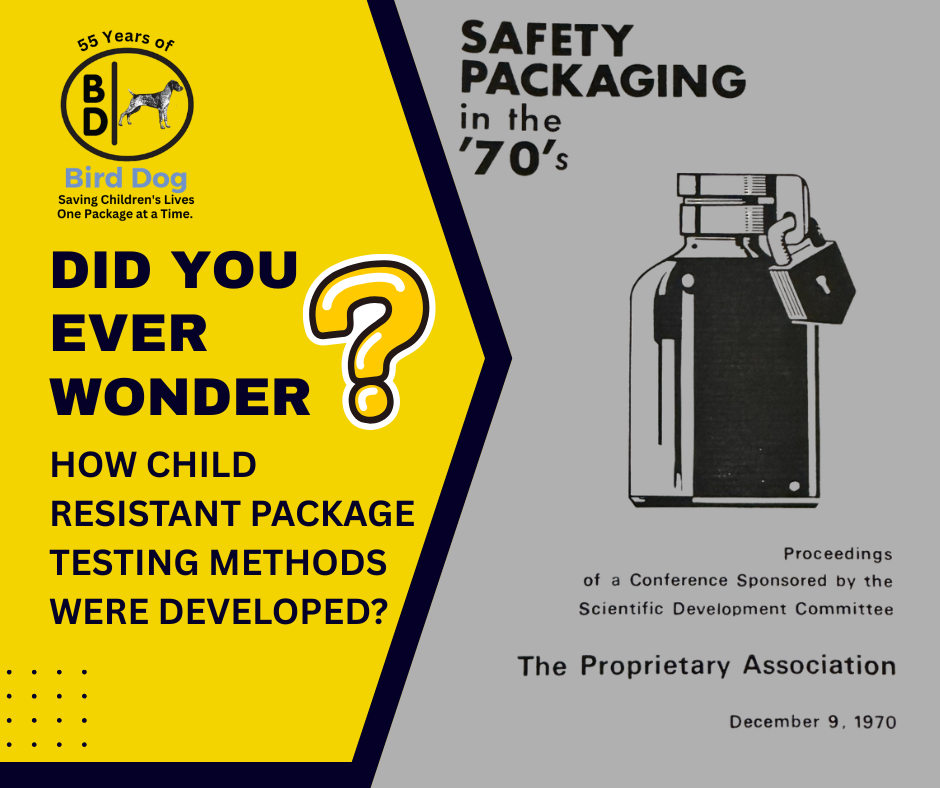
Fun Fact: Bird Dog Marketing Group actually has copies of the original documents.


The Need for Child-Resistant Packaging


The PPPA was established after mounting evidence highlighted the alarming number of children who were poisoning themselves by ingesting substances that were accessible in typical household packaging. Medications, cleaning products, and other potentially harmful items were often sold in bottles or containers that were too easy for children to open. To mitigate this risk, the PPPA mandated that these products be packaged in child-resistant packaging that would prevent children under the age of 5 from accessing the contents.


Crafting an effective definition of "child-resistant" packaging wasn't as simple as just setting an arbitrary age threshold. Regulators had to determine the appropriate criteria for testing packaging to ensure it was truly child-resistant.


The Key Ages: 5 and Under


The first step in determining who should be tested for child-resistant packaging was understanding how children of different ages interact with packaging. To conduct studies on child accessibility, the Consumer Product Safety Commission (CPSC), which administers the PPPA, needed to focus on a specific age group.


The CPSC's research team, working alongside child safety experts, recognized that children between the ages of 3 and 5 were the most likely to encounter and attempt to open hazardous packaging. A pivotal decision was then made to focus on the age range of 5 and under, as this group represents the broadest demographic at the highest risk for accidental ingestion.


Why this age group? Studies of child behavior, particularly regarding fine motor skills and problem-solving abilities, showed that children up to age 5 had the greatest difficulty with complex tasks like opening containers. At the same time, they were developing the curiosity and motor skills that made them more likely to engage with packaging.


For testing purposes, the packaging would be considered "child-resistant" if it was capable of preventing 80% of children in this age group from opening the container within a 10-minute period. It was also important to test the accessibility of packaging by children with varying degrees of dexterity, as children's abilities vary significantly based on age and development.


How Testing is Done


The PPPA regulations require that manufacturers perform specific child-resistance tests before marketing products in the U.S. The CPSC oversees this process, and the testing typically involves children ages 42 to 51 months (about 3.5 to 4.25 years): This group is considered to be at high risk for poisoning incidents and represents the average child in the highest-risk age range.


The Adult Test


In addition to the child-resistant tests, the PPPA requires that the same packaging be tested for use by adults 50 to 70 years of age, typically the older individuals who may have reduced strength or dexterity. Packaging must be easy for adults to open and close properly, especially for those with arthritis, hand weakness, or other disabilities.


The Ongoing Challenge of Child Safety


Manufacturers also face the challenge of designing packaging that strikes a balance between child resistance and consumer convenience. It's no easy feat to create a package that is both secure from a curious child and easy to use for an adult. In some cases, innovations in packaging design - such as push-and-turn caps or blister packs - have made a significant impact in keeping children safe while maintaining usability for adults.


Conclusion


The age ranges for child-resistant packaging testing under the PPPA were carefully determined based on research into the developmental stages of children and their ability to open various types of containers. By focusing on children under the age of 5, and using empirical data from studies on children's behavior and capabilities, the CPSC created a science-backed standard for preventing accidental poisonings in children.


As we move forward into an era of evolving consumer products, continuous improvement in packaging design and safety - standards will remain a key focus in protecting young children from preventable harm.


If you have any questions regarding child-resistant packaging and how to meet child-resistant package regulations - call Bird Dog Marketing Group LLC at 717-615-9022 or email sales@birddogmarketinggroup.com.


Bird Dog Marketing Group is an international industry leader in Child Resistant (CR) and Senior Adult Use Effectiveness (SAUE) protocol testing. For over 55 years, we have been providing comprehensive research and testing services and have a record of success in safety and child-resistant package testing. We have tested and evaluated thousands of different package types, including unit dose packages, pouches, bottles and containers with a variety of closures, aerosol cans, pump dispensers and more.


Our team provides an assurance of accuracy and hyper-focused attention to detail for all package testing.




By Mark Perkins January 22, 2026
The Critical Role of Quality Control in Manufacturing Child-Resistant Packaging In an increasingly safety-conscious marketplace, child-resistant packaging plays a vital role in protecting children from accidental ingestion of hazardous products. These specially designed packages are required for a broad range of consumer goods — from medications and cleaning supplies to small batteries and toxic chemicals. However, simply labeling a package as "child-resistant" is not enough; manufacturers and fillers alike must implement rigorous quality control (QC) systems to ensure that these safeguards perform exactly as intended every time. Why Child-Resistant Packaging Matters Child-resistant (CR) packaging is not about making things inconvenient — it is about saving lives. According to nonprofit poison control and public health data, children under the age of five are at the highest risk for accidental poisoning, and packaging that is truly child-resistant significantly reduces that risk. In many industries, compliance with federal and international standards (such as the U.S. Consumer Product Safety Commission's requirements or ISO standards) is mandatory — not optional. But compliance on paper does not automatically translate to safety in the field. That is where quality control makes the difference. Quality Control: The Foundation of Safety and Compliance Quality control in CR packaging means ensuring that every component, closure, and finished package meets documented safety standards and performs reliably. The stakes are high — failure of just a single CR feature can render the entire package ineffective and expose a company to serious legal, financial, and reputational harm. Here's why quality control is indispensable: 1. Assurance of Safety Performance Quality control helps manufacturers verify that child-resistant mechanisms (such as push-and-turn caps, squeeze-and-turn closures, or blister packaging) function correctly for children while remaining accessible to adults. Through standardized performance testing and inspection, QC confirms that a package will resist opening by young children — every time. Without QC, labels and design intent are irrelevant; an unsafe package on the shelf is a very real hazard. 2. Regulatory Compliance and Accountability Regulatory bodies require extensive documentation and adherence to precise criteria. QC systems record inspection results, test data, corrective actions, and traceability information that prove compliance during audits or investigations. An effective QC program is not simply good practice — it is the documentation that regulators and customers rely on. Examples of regulated industries requiring QC for CR packaging:  Pharmaceuticals and over-the-counter medications, household hazardous chemicals (cleaners, solvents, pesticides), batteries, and small components with ingestion risk Failing to maintain proper QC documentation can result in recalls, fines, or halted production lines. 3. Consistency Across Every Batch A single failure can erode consumer trust and lead to costly recalls. Quality control ensures consistency — verifying that each batch of packaging components and each filled product meets the same high standard as the first. Through statistical sampling, process controls, and routine inspection, QC identifies trends before they become systemic issues. 4. Protecting Brand Reputation and Legal Risk A recall — especially a recall involving potential child safety — can devastate a brand. Manufacturers and fillers with robust QC programs not only reduce the likelihood of product failures but also demonstrate to retailers, regulators, and consumers that safety is a core value. Insurance providers also consider QC rigor when underwriting liability coverage; better QC often translates to lower risk profiles and lower premiums. Why Quality Control Matters for Companies That Fill Child-Resistant Packages Many companies do not manufacture CR packaging components — they fill them. Whether it is a contract packager, a pharmaceutical contract manufacturer, or a co-packer for consumer goods, fill-finish operations are an essential link in the safety chain. These companies must take QC seriously for several reasons: 1. Ensuring End-to-End Safety A child-resistant package that leaves the CR manufacturer in perfect condition can still fail if it is improperly filled, misaligned, damaged, or compromised during closure. Fillers must implement QC checks for: Correct closure torque Alignment and integrity of safety features Cleanliness and absence of contamination Accurate labeling and sealing A company may be compliant at one stage, but failure downstream destroys that compliance and safety. 2. Shared Liability and Brand Trust When a filler packages a product for resale, they share responsibility for the safety and performance of that package. A failure traced back to the fill-finish process can result in legal exposure for both the filler and the brand owner. Rigorous QC — including documented protocols, training, and regular audits — helps protect all parties and assures retailers that products are safe for consumers. 3. Supply Chain Integration and Traceability Good QC is not siloed — it integrates across the supply chain. Filling companies must: Verify incoming CR packaging from suppliers Monitor environmental conditions (humidity, contamination) Track batches and maintain full traceability. In the event of an issue, swift traceability can pinpoint root causes and limit the scope of corrective action. Key Elements of an Effective Quality Control Program To be effective in the realm of child-resistant packaging, a QC program should include: Documented Standard Operating Procedures (SOPs) Clear instructions for every step — from receiving components to finished product release. Incoming Inspection of Packaging Components Verification of compliance with safety standards before use. In-Process Monitoring Routine checks during filling and closure to ensure mechanisms function as designed. Performance Testing Regular evaluation of CR features with child-resistance testing protocols and adult usability checks. Defect Tracking and Corrective Actions Data collection, analysis of trends, and timely corrective measures when issues arise. Training and Competency Assessments Workers must understand the importance of every QC step and how it affects safety and compliance. Traceability and Recordkeeping Batch records, inspection logs, and test results must be retained and easily retrievable. Conclusion: Quality Control is Not Optional — It is Essential Child-resistant packaging is more than a label or a design — it is a commitment to safety. Without strong quality control systems at both the manufacturing and filling stages, that commitment is hollow. Companies that invest in robust QC protect children, comply with regulations, safeguard their brand reputation, and reduce financial and legal risk. In a marketplace where consumer safety is paramount, quality control is not just recommended — it is essential. If you have any questions regarding child-resistant packaging and how to meet child-resistant package regulations - call the global leader - Bird Dog Marketing Group LLC at 717-615-9022 or email sales@birddogmarketinggroup.com. Bird Dog Marketing Group is an international industry leader in Child Resistant (CR) and Senior Adult Use Effectiveness (SAUE) protocol testing. For over 55+ years, we have been providing comprehensive research and testing services and have a record of success in safety and child-resistant package testing. We have tested and evaluated thousands of different package types, including unit dose packages, pouches, bottles, and containers with a variety of closures, aerosol cans, pump dispensers and more. Our team provides an assurance of quality, accuracy, and hyper-focused attention to detail for all package testing.
By Mark Perkins November 20, 2025
The Holidays Are Coming — Let Us Celebrate Safely!
By Mark Perkins October 30, 2025
Every year, thousands of children are rushed to emergency rooms after accidentally ingesting household products or medications that were not properly secured. The incidents are tragic—and often preventable. That is why the Poison Prevention Packaging Act (PPPA) exists. Enacted in 1970 , the PPPA requires that many everyday substances—such as prescription drugs, over-the-counter medications, cleaning products, and certain chemicals—be packaged in child-resistant containers . These are designed to be difficult for young children to open, but accessible for adults. Why the PPPA Matters Before the PPPA, accidental poisonings were one of the leading causes of death among children under five years old in the United States. Since its implementation, the law has saved countless lives by dramatically reducing incidents of accidental ingestion. It is not just about compliance; it is about responsibility. Child-resistant packaging creates a crucial barrier between children's natural curiosity and potentially lethal substances. Even one oversight—one improperly packaged product—can have devastating consequences for a family. It is Not a Recommendation. It is Law! The PPPA is federal law enforced by the Consumer Product Safety Commission (CPSC) . Manufacturers, packagers, and distributors must comply with their requirements. Noncompliance can result in serious legal and financial penalties—not to mention the ethical cost of endangering public safety. Every organization involved in the manufacture or distribution of regulated products should treat PPPA compliance as non-negotiable. This includes ensuring that: All applicable products use approved child-resistant packaging. Packaging designs are tested and certified. Staff are trained in PPPA requirements. Documentation is maintained for audits or inspections. An SOP (Standard Operating Procedure) for your CR testing requirements are strongly recommended. Protecting Children Is Everyone's Duty Child safety should never be taken lightly. The PPPA stands as one of the most impactful public health laws in U.S. history, and it remains just as vital today as it was over fifty years ago. Whether you work in package manufacturing, pharmaceuticals, consumer healthcare, agriculture, chemical, cannabis, retail or any industry that uses special packaging—your role in preventing accidental poisonings matters. Compliance is not optional. It is the law , and more importantly, it is a commitment to protecting the most vulnerable among us. If you have any questions regarding child-resistant packaging and how to meet child-resistant package regulations - call Bird Dog Marketing Group LLC at 717-615-9022 or email sales@birddogmarketinggroup.com. Bird Dog Marketing Group is an international industry leader in Child Resistant (CR) and Senior Adult Use Effectiveness (SAUE) protocol testing. For over 55 years, we have been providing comprehensive research and testing services and have a record of success in safety and child-resistant package testing. We have tested and evaluated thousands of different package types, including unit dose packages, pouches, bottles, and containers with a variety of closures, aerosol cans, pump dispensers and more. Our team provides an assurance of accuracy and hyper-focused attention to detail for all package testing.
By Mark Perkins September 15, 2025
Our Commitment to Quality and Innovation
Hands outstretched with a globe hovering above.
By Mark Perkins April 28, 2025
Since 1969, Bird Dog Marketing Group has emerged as a global leader in child-resistant (CR) package testing.
Photo of computer laptop screen, tiny shopping cart holding medicine bottles.
By Mark Perkins March 13, 2025
As e-commerce continues to surge, the importance of child-resistant packaging has never been more critical.
Young child sitting on the floor with open medicine containers.
By Mark Perkins November 4, 2024
The Poison Prevention Packaging Act: A Milestone in Child Safety
Photo of spray bottle for cleaning supplies and words reading Child-Resistant, Not Child-Proof.
By Mark Perkins October 17, 2024
Dispelling the Myth: Why There is No Such Thing as Child-Proof Packaging. In the realm of product safety, particularly concerning items like medications, household cleaners, and chemicals, the term "child-proof packaging" is commonly used. However, despite its widespread usage, the concept of truly child-proof packaging is a misnomer. We will delve into why there's no such thing as completely child-proof packaging and what measures can be taken to enhance child safety.
Young girl in a ballet outfit sitting on a windowsill looking outside.
By Mark Perkins October 17, 2024
Every year, thousands of children under the age of five face serious health risks due to unintentional poisonings. This article will review the statistics, explain how child-resistant packaging works, and detail how parents can help keep their children safe from accidental poisoning.
People sitting at an expo booth with banner sign behind them requesting help for package testing.
By Mark Perkins June 5, 2024
Our test proctors administering adult-use package testing are often asked, “Why are you only testing adults 50-70 years of age?” Here’s the story behind that decision. When the U.S. Congress passed the Poison Prevention Packaging Act of 1970 (PPPA), the Consumer Product Safety Commission (CPSC) required child-resistant packaging for specific drugs and household chemicals that could harm children. Package manufacturers developed and introduced new child-resistant packaging to comply with the requirements. Per the PPPA, the specialty packaging required certification that they were child-resistant. At the time, the adult-use effectiveness portion of the package test protocols included adult test subjects 18-45 years of age, a significant change from our current adult-use effectiveness subjects who are 50-70.