Child-Resistant Packaging: Why Life-Cycle Performance Is Just as Important as Initial Certification
Have we proven it stays child-resistant for the entire life of the package?
Child-resistant (CR) packaging is not just a regulatory checkbox—it is a critical safety system. Whether for pharmaceuticals, animal health, agriculture, cannabis products, household chemicals, or nicotine products, CR packaging exists for one reason: to protect children from accidental ingestion or exposure.
Yet one of the most common and costly mistakes companies make is assuming that once a package passes child-resistance testing, the job is done.
It is not.
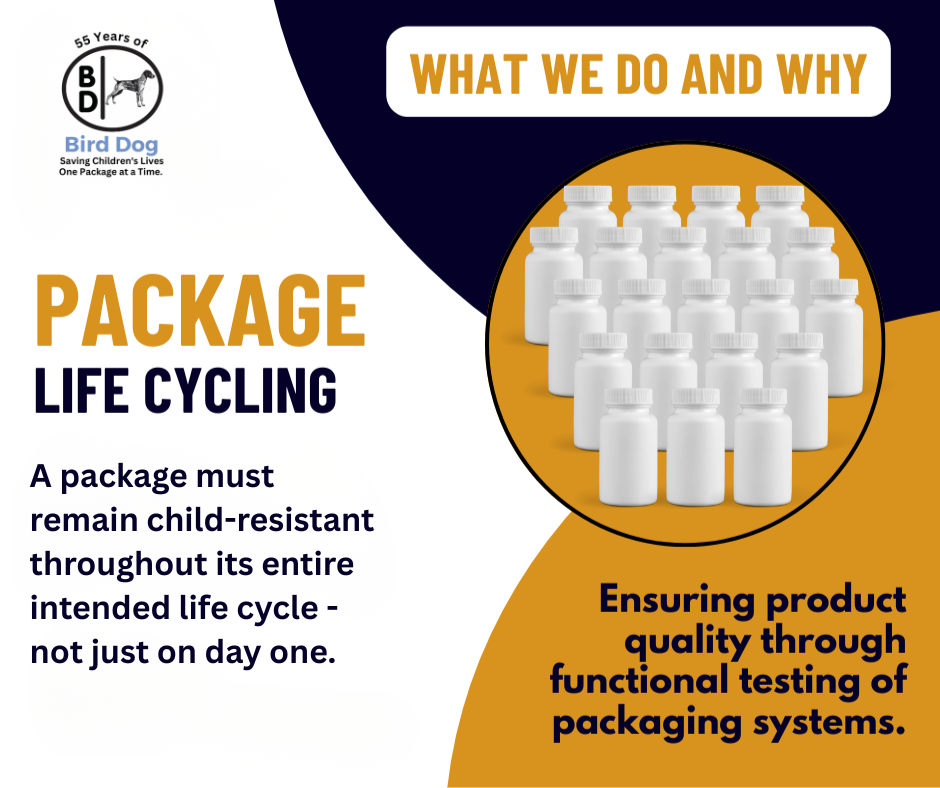
A package must remain child-resistant throughout its entire intended life cycle—not just on day one.
Certification Is the Beginning—Not the End.
In the United States, child-resistant packaging is governed by the Poison Prevention Packaging Act (PPPA) and enforced by the U.S. Consumer Product Safety Commission (CPSC). Testing protocols such as 16 CFR §1700.20 evaluate whether children can access the contents within a defined test period.
These tests are rigorous. But here is the key issue:
Most certification testing evaluates new packages - not packages after repeated consumer use.
In real-world conditions, packaging is:
- Opened and closed repeatedly
- Dropped
- Exposed to temperature changes
- Subjected to torque variation
- Handled by consumers with different strength profiles
If the closure system degrades, loosens, cracks, or loses alignment, child resistance can be compromised—even if the original design passed testing.
Why Life-Cycle Performance Matters
Child-resistant systems typically rely on:
- Push-and-turn mechanisms
- Squeeze-and-turn features
- Alignment arrows
- Locking tabs
- Blister tear strength
All these features can degrade over time.
Common failure modes include:
- Thread wear reducing required torque
- Plastic creep in snap features
- Tab fatigue or breakage
- Liner compression set
- Dimensional changes from environmental exposure
If the required opening force or alignment precision decreases below tested thresholds, the package may no longer meet compliance requirements—exposing the brand to regulatory risk and liability.
Two Critical Approaches to Life-Cycle Validation
1. Simulated Use Testing (Open/Close Cycling)
This method replicates the expected number of consumer uses.
For example:
- A 30-count medication bottle may be opened 30-60 times.
- A multi-dose cannabis container may be opened dozens of times over weeks.
Testing includes:
- Cycling the closure the full expected number of uses before CR testing.
- Measuring removal torque before, during, and after cycling
- Inspecting mechanical engagement features
- Re-testing child resistance after conditioning
This approach directly validates real-world performance.
2. Wear & Measurement Studies
This approach evaluates dimensional and mechanical degradation over time.
Key metrics include:
- Thread pitch and profile integrity
- Cap skirt deformation
- Engagement depth
- Tab retention force
- Material creep under stress
- Torque decay curves
Wear studies are particularly important when:
- Using new resin formulations
- Lightweighting components
- Changing mold tooling
- Switching manufacturing sites
Even minor dimensional shifts can significantly affect child-resistant performance.
The Hidden Risk: Manufacturing Variability
Many compliance failures occur not because of design intent - but because of production drift.
Tool wear, resin lot variation, or process changes can reduce performance margins. Without life-cycle validation protocols in place, these shifts may go undetected until a complaint or audit occurs.
Proactive companies build:
- Periodic requalification testing
- Statistical torque monitoring
- Accelerated aging studies
- Environmental conditioning protocols
into their quality systems.
Regulatory and Legal Exposure
If a package fails in the field after repeated use, regulatory bodies may determine it was never compliant under foreseeable use conditions.
That can mean:
- Product recalls
- Civil penalties
- Litigation exposure
- Brand damage
Child-resistant performance is not just about passing a lab test—it is about defending the package's safety under real consumer behavior.
Best Practices for Maintaining Compliance
- Define expected number of consumer uses
- Conduct open/close cycle validation
- Measure torque decay over time
- Perform dimensional wear analysis
- Include environmental conditioning
- Re-test after design or material changes
- Document protocols thoroughly
Most importantly:
Treat child-resistant performance as a life-cycle requirement, not a one-time certification event.
Final Thought
In packaging development, it is easy to focus on innovation, sustainability, cost reduction, and speed to market.
But when it comes to child-resistant systems, durability equals safety.
The true measure of compliance is not whether a package passes on day one - it is whether it protects children on day thirty or longer.
And that requires intentional life-cycle validation.
If your organization is developing or modifying CR packaging, now is the time to ask:
Have we proven it stays child-resistant for the entire life of the package?
If you have any questions regarding child-resistant packaging and how to meet child-resistant package regulations - call the global leader - Bird Dog Marketing Group LLC at 717-615-9022 or email sales@birddogmarketinggroup.com.
Bird Dog Marketing Group is an international industry leader in Child Resistant (CR) and Senior Adult Use Effectiveness (SAUE) protocol testing. For over 55 years, we have been providing comprehensive research and testing services and have a record of success in safety and child-resistant package testing. We have tested and evaluated thousands of different package types, including unit dose packages, pouches, bottles, and containers with a variety of closures, aerosol cans, pump dispensers and more.
Our team provides an assurance of quality, accuracy, and hyper-focused attention to detail for all package testing.